
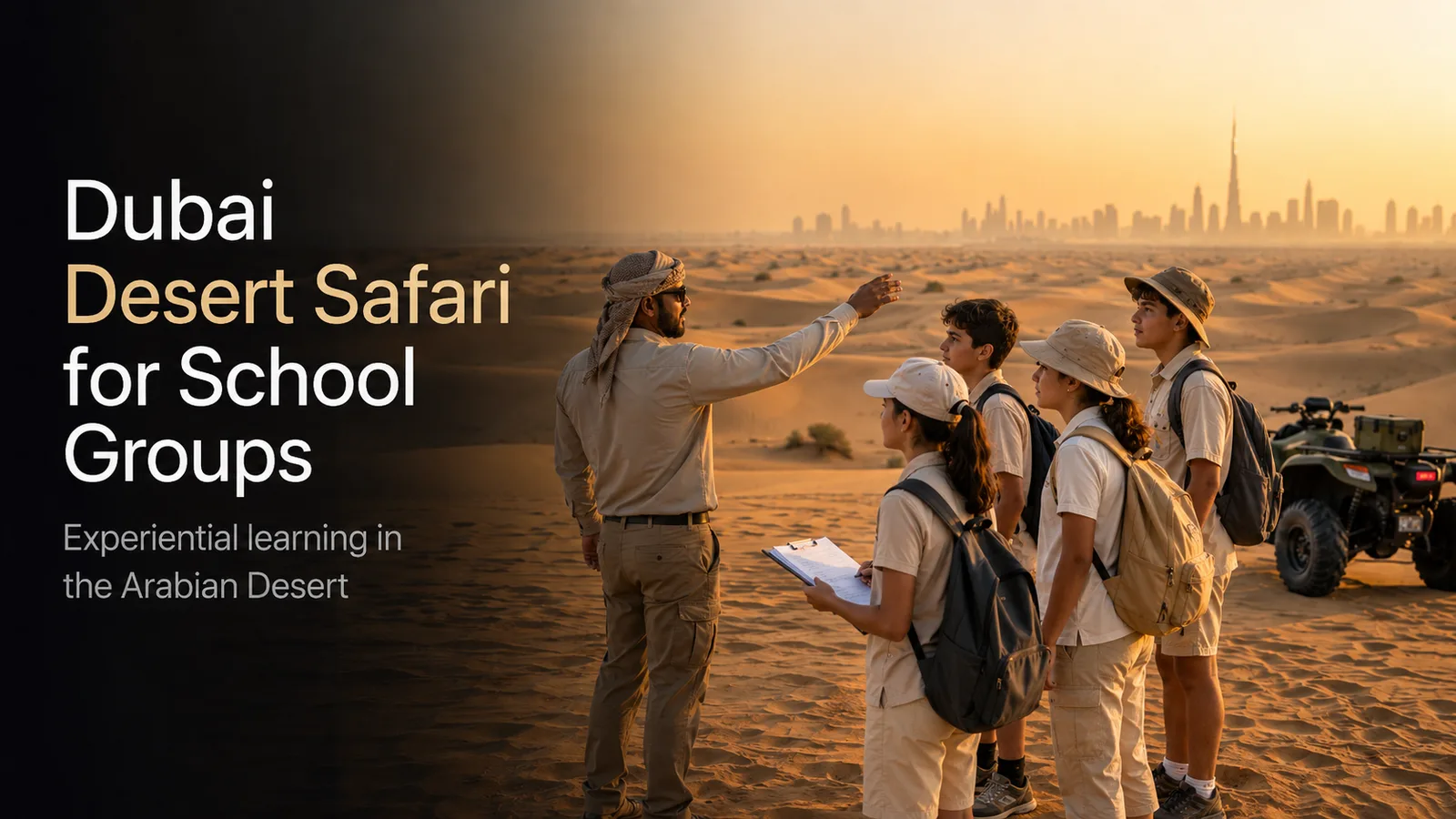
A Dubai desert safari is often seen as an adventure tourism product, but in an educational context it becomes something far more structured and academically valuable. When designed properly, a desert safari in the Arabian Desert transforms into an experiential learning environment where students engage directly with geography, physics, ecology, and cultural history. Instead of being a simple recreational trip, it becomes a multidisciplinary outdoor classroom connected to real world systems, scientific principles, and human heritage.
The core foundation of a Dubai educational desert safari is experiential learning. This approach emphasizes learning through doing, where students actively participate in activities rather than passively receiving information. In the desert environment, this means observing dunes, analyzing movement patterns, studying vehicle mechanics, and understanding how ecosystems survive in extreme conditions. The result is a learning experience that is both memorable and academically meaningful.
The Arabian Desert as a Natural Outdoor Classroom
The Arabian Desert surrounding Dubai provides a unique geographical and scientific learning environment. It is not just a backdrop for tourism but a dynamic system of dunes, wind patterns, temperature variations, and ecological adaptation. For school groups, this environment becomes a real world laboratory where theoretical concepts from textbooks become visible and measurable.
The dune systems of the Arabian Desert are especially important for geography and earth science education. A dune is not a static structure but a constantly shifting landform shaped by wind movement. Students can observe how sand accumulates, shifts, and reforms over time. This connects directly to lessons in dune geomorphology, erosion, and sediment transport.
In an educational desert safari, students begin to understand that landscapes are not fixed images but evolving systems influenced by natural forces. This shift in perception is one of the most powerful outcomes of field based learning in Dubai’s desert environment.
Experiential Learning Through Desert Safari Activities
Experiential learning is the pedagogical foundation of a Dubai desert safari designed for school groups. Instead of learning abstract concepts in a classroom, students engage with physical environments where those concepts are actively demonstrated.
When students observe or participate in controlled all terrain vehicle experiences, they are introduced to mechanical principles such as motion, friction, acceleration, and balance. The all terrain vehicle, commonly known as a quad bike, becomes a practical teaching tool for physics and engineering concepts. Students can see how tire pressure affects movement on sand, how traction changes on loose surfaces, and how weight distribution impacts control.
This form of experiential learning enhances retention because students are not only hearing about scientific principles but witnessing them in action. The connection between theory and reality becomes immediate and tangible.
All Terrain Vehicles and STEM Education in the Desert
All terrain vehicles play a significant role in STEM focused desert safari programs. In a controlled educational setting, quad bikes are not just recreational machines but structured learning instruments. They demonstrate mechanical physics in a way that is impossible to replicate inside a classroom.
When a quad bike moves across a dune, it interacts directly with variables such as friction, incline angle, and surface resistance. Students can observe how small changes in speed or direction affect stability. These observations can be linked to Newtonian mechanics and real world engineering principles.
In addition, the design of all terrain vehicles introduces students to concepts of mechanical engineering. Tire structure, suspension systems, and engine power are all visible and explainable in a desert environment. This allows educators to build lessons around applied physics rather than theoretical equations alone.
A desert STEM field trip using quad bikes creates an interactive platform where students connect science, mathematics, and engineering in a single physical experience.
Dunes as a Living Laboratory for Geography and Environmental Science
The dunes of the Arabian Desert are central to environmental and geographical education. Each dune represents an active system shaped by wind direction, sand availability, and environmental conditions. For students, this provides a direct example of how natural forces shape landforms over time.
In a structured educational desert safari, students can study how dunes migrate, how vegetation affects sand stability, and how climate influences desert ecosystems. These observations form the basis for understanding larger environmental systems such as desertification, climate adaptation, and sustainable land use.
The study of dunes also connects to conservation biology. While deserts may appear empty, they are home to specialized species that have adapted to extreme conditions. Understanding how ecosystems survive in harsh environments helps students appreciate biodiversity and ecological balance.
Cultural Education Through Bedouin Heritage
A Dubai desert safari for school groups is not limited to science and geography. It also provides a strong cultural and historical learning dimension through Bedouin heritage education. The Bedouin people historically inhabited the Arabian Desert and developed survival strategies that allowed them to thrive in extreme conditions.
Students can learn about traditional Bedouin navigation techniques, water conservation methods, and nomadic lifestyles. These cultural lessons provide context for understanding human adaptation to harsh environments.
By integrating cultural history into the educational desert safari, students gain a broader perspective on how geography influences human civilization. The desert becomes not only a physical space but also a cultural landscape shaped by generations of human experience.
Conservation Biology and Sustainability Education
Conservation biology plays a critical role in modern educational desert safari programs in Dubai. The focus is on teaching students how ecosystems function and why biodiversity protection is essential, even in desert environments.
The Arabian Desert is often misunderstood as lifeless, but it contains a delicate ecological balance. Plants and animals have evolved unique survival strategies, and human activity can significantly impact this balance. Through guided educational tours, students learn how tourism, including all terrain vehicle usage, must be managed responsibly to avoid environmental degradation.
This introduces the concept of sustainable tourism, where human enjoyment of natural environments is balanced with ecological preservation. Students begin to understand that activities like dune exploration and vehicle movement must be regulated to protect fragile ecosystems.
Safety and Regulation in School Desert Safari Programs
Safety is a fundamental requirement in any educational desert safari for school groups. In Dubai, school trips are regulated by the Knowledge and Human Development Authority, which ensures that educational excursions meet strict safety and supervision standards.
School group quad biking activities are typically conducted under controlled conditions, with trained instructors and defined safety zones. Risk assessments are carried out before any activity begins, and students are usually grouped based on age and ability.
The emphasis on Dubai student safari safety ensures that educational value does not compromise physical well being. Helmets, supervision protocols, and restricted speed limits are commonly implemented during all terrain vehicle sessions.
Educational institutions also coordinate closely with licensed tour operators to ensure compliance with safety regulations. These operators are responsible for maintaining equipment, providing trained guides, and implementing emergency procedures if required.
Physics and Mechanics in Real World Desert Conditions
One of the most powerful educational outcomes of a desert STEM field trip is the application of physics in real world conditions. Concepts such as velocity, friction, inertia, and force become visible when students observe or engage with movement across sand dunes.
For example, when an all terrain vehicle climbs a dune, it experiences increasing resistance due to gravity and sand displacement. When descending, acceleration increases due to slope angle and reduced friction. These dynamics allow students to directly observe Newton’s laws of motion in action.
Sand itself becomes a teaching material. Its behavior under pressure demonstrates principles of granular physics, including compaction and displacement. This transforms the desert into a natural physics laboratory where abstract concepts become observable phenomena.
Educational Benefits of Desert Safari Programs
The educational benefits of a Dubai desert safari extend beyond science and geography. Students develop critical thinking, observational skills, and environmental awareness through direct interaction with natural systems.
Experiential learning in the desert improves knowledge retention because students engage multiple senses during the learning process. Visual observation, physical movement, and guided explanation work together to reinforce academic concepts.
Additionally, group based desert activities encourage teamwork, communication, and problem solving. These soft skills are essential in modern education and are naturally developed during structured field experiences.
Educational desert safaris also help students understand sustainability and environmental responsibility. By witnessing fragile ecosystems firsthand, students gain a deeper appreciation for conservation efforts and responsible tourism practices.
Planning a Safe and Effective School Desert Safari
Organizing a safe educational desert safari requires careful coordination between schools, tour operators, and regulatory authorities. Risk management is a central component of planning, ensuring that all activities are appropriate for student age groups and physical capabilities.
Proper planning includes selecting certified tour operators, defining activity boundaries, and ensuring adequate supervision ratios. School administrators often evaluate safety protocols, emergency procedures, and equipment standards before approving any trip.
Clear communication between educators and tour providers ensures that the educational objectives are aligned with safety requirements. This balance between learning and risk control is essential for successful field based education in desert environments.
Conclusion
A Dubai desert safari as an educational experience for school groups represents a powerful integration of science, culture, and experiential learning. The Arabian Desert becomes a living classroom where students study dunes, physics, ecology, and Bedouin heritage in a real world context.
When structured correctly, activities such as all terrain vehicle demonstrations, dune observation, and conservation education transform into meaningful academic experiences. At the same time, regulatory frameworks such as KHDA guidelines ensure that student safety remains a top priority.
The result is a balanced educational model where adventure supports learning, and learning deepens appreciation of the natural world. A Dubai desert safari, when designed for school groups, is not just a trip, it is an immersive educational system grounded in experiential learning and real world discovery.